📌 Key Takeaways
- The U.S. stock market fell sharply on June 5, 2026, after May’s jobs report showed 172,000 new jobs — roughly double what economists expected.
- Strong jobs data triggered a “good news is bad news” market reaction, because it raised fears that the Federal Reserve will hike interest rates.
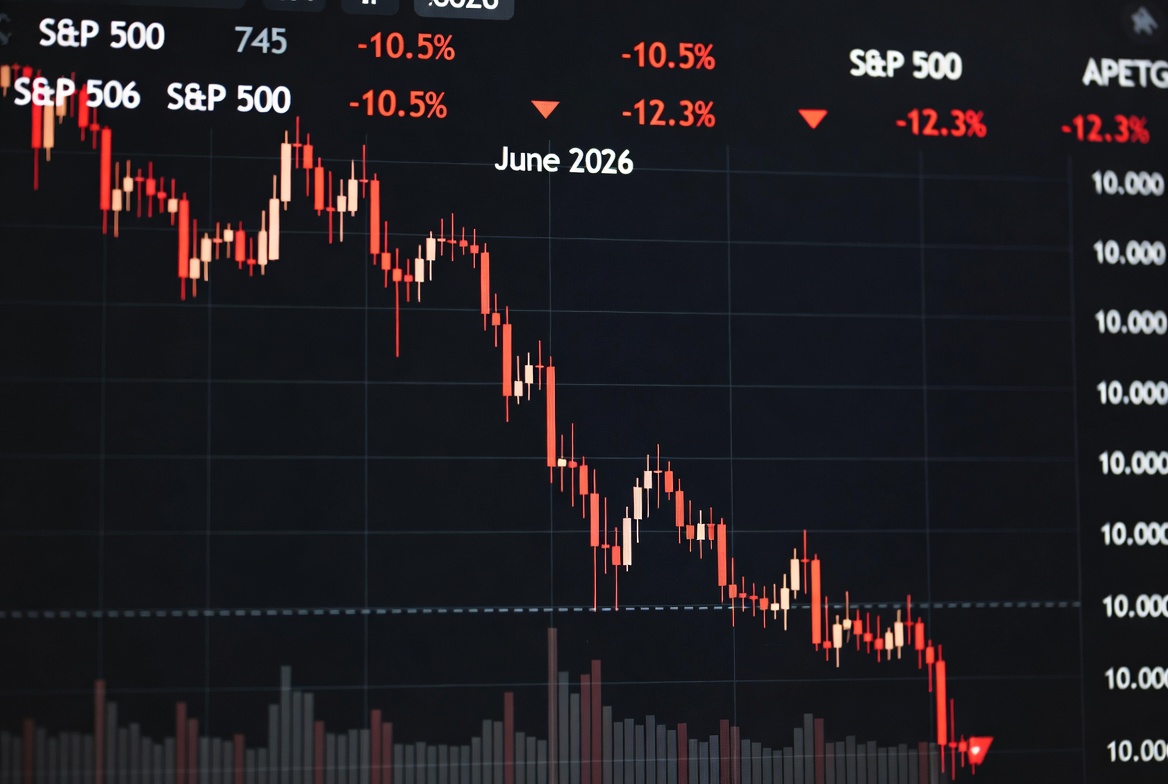
- The S&P 500 dropped 2.6%, the Nasdaq plunged over 4%, and tech stocks like Nvidia fell hard.
- Higher interest rates hurt growth stocks — especially AI and technology companies — by making their future earnings worth less today.
- Short-term volatility is normal. Understanding why markets fall helps you make smarter, calmer decisions with your money.
Stock Market Down Today? Here’s Why Strong Jobs Data Sent Stocks Lower
You checked your portfolio this morning and everything was down. The headlines all say the jobs report was great — so why is the stock market down today?
This is one of the most confusing moments for everyday investors. You’d expect good economic news to push markets higher. But on June 5, 2026, the opposite happened. A blowout jobs report sent stocks tumbling — and if you don’t understand why, it can feel deeply unsettling.
The short answer: strong jobs data makes investors worried that the Federal Reserve will raise interest rates. Higher rates are bad for stocks — especially fast-growing technology companies. That fear triggered a broad sell-off across U.S. markets.
In this article, you’ll learn exactly what happened, why markets responded the way they did, and what this means for your investments going forward.
What Is the “Why Is the Stock Market Down Today” Question Really Asking?
When investors ask why is the stock market down today, they’re usually asking one of two things: what specific event triggered the sell-off, and what does it mean for their money.
Today’s trigger was the May 2026 nonfarm payrolls report — the monthly government data that shows how many jobs the U.S. economy added. It’s one of the most closely watched economic indicators in the world.
The report came in far above expectations, and markets didn’t like it. To understand why, you need to know how the Federal Reserve and interest rates connect to stock prices.
How Does the Jobs Report Affect the Stock Market?
The jobs report — formally called the nonfarm payrolls (NFP) report — is released by the U.S. Bureau of Labor Statistics (BLS) on the first Friday of each month. It tells you how many jobs were created outside of agriculture.
Here’s the chain reaction that moves markets:
- Strong jobs data → suggests the economy is running hot
- Hot economy → risks higher inflation
- Higher inflation fears → the Federal Reserve may raise interest rates
- Higher interest rates → borrowing becomes more expensive for businesses and consumers
- Expensive borrowing → lower corporate profits, slower growth
- Slower growth outlook → investors sell stocks, especially growth stocks
This chain is why a jobs number that looks good on the surface can actually hurt stock prices. Traders call it the “good news is bad news” phenomenon.
Formula (simplified): Strong Jobs Report → ↑ Rate Hike Expectations → ↑ Bond Yields → ↓ Stock Valuations
It’s counterintuitive — but once you see the logic, it makes complete sense.
Read More : ETF vs Mutual Funds: 5 Important Differences for Smart Investors
What Happened on June 5, 2026? A Real-World Example
Here’s exactly what occurred on Friday, June 5, 2026, and why it rocked global markets.
The Jobs Report Numbers:
- Jobs added in May 2026: 172,000
- Economists’ consensus forecast: approximately 88,000
- Actual vs. expected: roughly double the forecast
- Unemployment rate: held steady at 4.3%
The report also included upward revisions to March and April job gains, reinforcing the picture of a resilient labor market.
The Market Reaction:
| Index | Move on June 5, 2026 |
|---|---|
| S&P 500 | −2.6% (worst single-day drop since October 2025) |
| Nasdaq Composite | −4.1% to −4.2% |
| Dow Jones Industrial Average | −1.3% to −1.4% |
| Nvidia (NVDA) | −6% |
| Micron, Marvell Technology | −~5% each |
The S&P 500 closed at 7,383.74, snapping a nine-week winning streak.
Why tech stocks fell hardest:
Technology and AI-related stocks are especially sensitive to interest rate expectations.1 When rates rise, investors discount future earnings more aggressively — which makes high-growth companies look less attractive compared to safer options like bonds. Higher rates also raise borrowing costs for tech companies that fund the AI boom with cheap debt

Key Reasons Why is the Stock Market Down Today
Here are the five core reasons behind today’s sell-off — explained simply.
1. The Jobs Report Blew Past Expectations
When economic data far exceeds consensus forecasts, it shocks markets. Investors had positioned themselves for a modest jobs number. The actual figure of 172,000 — roughly twice what was expected — forced a rapid repricing of rate expectations across the board.
2. The Fed Rate Hike Probability Jumped
After the report, economists estimated a roughly 60–70% probability of at least one Federal Reserve rate hike before the end of 2026. Before the data dropped, rate hikes were barely on the table. That sudden shift in expectations hits stock valuations hard and fast.
The Fed’s next scheduled meeting is June 16–17, 2026. Policymakers are expected to hold rates steady there. However, traders are now watching December closely.
3. Treasury Yields Rose Sharply
When rate hike bets increase, bond yields follow. Higher yields on U.S. Treasury bonds make them more attractive relative to stocks — pulling money out of equities and into fixed income. This “competition” from bonds is one of the most direct ways that rate expectations suppress stock prices.
4. Tech and AI Stocks Were Already Vulnerable
Big Technology companies had powered the S&P 500 to a series of record highs over the previous two months. The index was already up 7.9% for the year before Friday’s drop. Stocks that have run up that far are more exposed when sentiment turns.
Additionally, AI-related stocks were already under pressure following a disappointing earnings report from Broadcom earlier in the week. The jobs report was the catalyst that accelerated existing weakness.
5. “Good News Is Bad News” Psychology
Markets don’t trade on reality alone — they trade on expectations vs. reality. When the economy looks too strong, investors fear the Fed’s response more than they cheer the growth. That’s the core of today’s sell-off. It’s not that jobs are bad. It’s that too many jobs too quickly signals a Fed that will act.
Common Mistakes Investors Make During Market Sell-Offs
When markets drop sharply, emotions run high. Here are four mistakes to avoid.
1. Panic selling at the bottom Selling after a sharp decline locks in your losses and means you’ll likely miss the recovery. Market history consistently shows that investors who stay invested through volatility tend to recover and grow over time.
2. Assuming today’s drop predicts a crash One bad day — or even one bad week — is not a reliable signal of a prolonged bear market. The S&P 500 snapped a nine-week win streak today. Pull-backs are a normal feature of healthy markets, not a sign of collapse.
3. Ignoring the broader portfolio context Rising interest rate expectations are not universally bad. Banking and financial sector stocks often perform better in higher-rate environments. A diversified portfolio can cushion the blow from a tech-driven sell-off.
4. Overreacting to a single data point One jobs report doesn’t define the trajectory of the economy or markets. The Fed weighs months of data — inflation, employment, GDP — before making policy decisions. One strong print doesn’t guarantee a rate hike.
Stock Market Down: Growth Stocks vs. Value Stocks During Rate Hike Fears
| Feature | Growth Stocks (e.g., Tech/AI) | Value Stocks (e.g., Banks, Energy) |
|---|---|---|
| Sensitivity to rate hikes | Very High | Low to Moderate |
| Valuation method | Future earnings (discounted) | Current earnings/assets |
| Performance when rates rise | Often falls sharply | Can outperform |
| Examples | Nvidia, Micron, Marvell | JPMorgan, ExxonMobil |
| Risk in today’s environment | Higher | Lower |
This is why today’s rate hike fears disproportionately hammered the Nasdaq (tech-heavy) versus the Dow Jones (more diversified, includes banks and industrials).
How to Get Started: 5 Steps to Navigate a Market Sell-Off
If today’s drop has you worried, here’s a practical, calm approach.
Step 1: Don’t open your portfolio every 30 minutes. Constant checking amplifies anxiety and leads to impulsive decisions. Check in once a day, or less.
Step 2: Review your investment time horizon. If you’re investing for 5, 10, or 20+ years, a single-day drop of 2–4% is statistically insignificant. Short-term investors need to manage risk differently.
Step 3: Check your exposure to rate-sensitive sectors. If your portfolio is heavily concentrated in high-growth tech stocks, consider whether your risk level still matches your goals. Diversification across sectors and asset classes can reduce volatility.
Step 4: Consider whether this creates a buying opportunity. Many long-term investors use sharp drops to add to positions in quality companies at lower prices. This is not advice to buy anything specific — but it’s a perspective worth considering with a qualified advisor.
Step 5: Consult a financial professional before making major moves. A certified financial advisor (CFP in the US, equivalent qualifications internationally) can help you evaluate whether changes to your portfolio are warranted based on your personal situation.
Frequently Asked Questions (FAQ)
Why is the stock market down today after a strong jobs report?
Many investors are wondering why the stock market down today story is dominating headlines despite positive economic news. A stronger-than-expected jobs report suggests the economy may be growing too quickly, which can increase inflation risks. This often leads investors to believe the Federal Reserve could raise interest rates. Higher rates typically hurt stock valuations, helping explain why the stock market down today reaction occurred across major indexes.
What does the nonfarm payrolls report measure?
The nonfarm payrolls (NFP) report measures how many jobs were added to the U.S. economy outside the agricultural sector during the previous month. Published by the U.S. Bureau of Labor Statistics, it is one of the most closely watched economic reports because it can influence Federal Reserve policy and market sentiment. In situations like the stock market down today sell-off, investors pay especially close attention to NFP data.
Will the Federal Reserve raise interest rates in 2026?
While no future rate decision is guaranteed, the strong May 2026 jobs report increased expectations that the Federal Reserve could consider another rate hike later in the year. Markets continuously adjust their expectations based on inflation, employment, and economic growth data. Concerns about potential rate increases were a major reason behind the stock market down today movement.
Why did the Nasdaq fall more than the Dow Jones?
The Nasdaq contains a larger concentration of technology and AI-related companies, which are highly sensitive to interest rate expectations. When investors anticipate higher rates, future earnings become less valuable in today’s dollars, putting pressure on growth stocks. This is why the Nasdaq suffered larger losses during the stock market down today decline, while the Dow Jones held up relatively better.
What does “good news is bad news” mean in the stock market?
The phrase “good news is bad news” describes situations where positive economic data causes stock prices to fall. Strong job growth, rising consumer spending, or robust economic activity can increase fears of higher interest rates. As a result, investors may sell stocks even when the economy appears healthy. This unusual dynamic was one of the biggest reasons the stock market down today trend developed after the latest jobs report.
Should investors worry when the stock market is down today?
A single day of market losses does not necessarily indicate a long-term market downturn. Short-term volatility is a normal part of investing, and periods when the stock market down today can often be followed by recoveries. Long-term investors generally focus on their financial goals, diversification, and overall strategy rather than reacting to daily market fluctuations.
Why the Stock Market Is Down Today: Final Thoughts
So — why is the stock market down today? The May 2026 jobs report delivered a number that was nearly double what Wall Street expected, triggering a sharp repricing of Federal Reserve rate hike expectations. That fear spread quickly through markets, hitting tech and AI stocks hardest, pushing the S&P 500 down 2.6% and the Nasdaq over 4%.
Understanding why the stock market is down today — even when the underlying news seems positive — is one of the most valuable skills an investor can develop. Markets are driven by expectations, not just reality. When you know the rules, the volatility becomes far less frightening. Stay calm, review your strategy, and remember: short-term drops are a feature of investing, not a flaw.
Reviewed by: The Finance Orbit Editorial Team
Disclaimer: This article is for educational purposes only and does not constitute financial advice. All investment decisions carry risk. Please consult a qualified financial advisor before making any investment decisions. Rules, regulations, and market conditions vary by country.