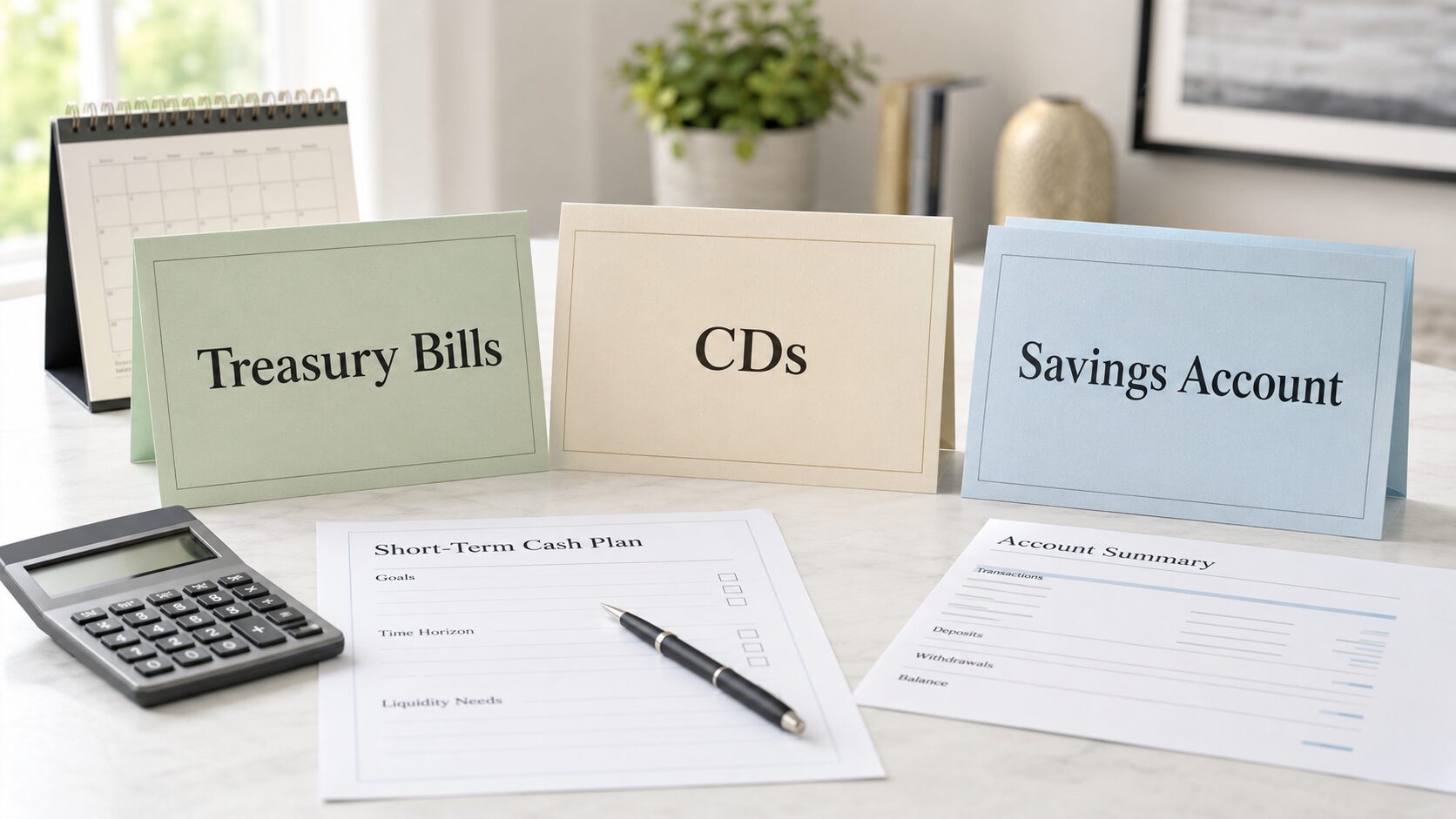
Quick Answer: Treasury bills vs CDs comes down to government-backed securities versus bank time deposits. Treasury bills can be attractive for short-term cash because they are backed by the U.S. government and interest is generally exempt from state and local income taxes. CDs can work well when you want FDIC-insured bank deposits and a fixed term, while savings accounts are usually best for emergency cash because they are the most flexible.
Cash is not one-size-fits-all. Money for next month’s rent, a six-month emergency fund, a property-tax bill, and a house down payment should not always sit in the same place. Treasury bills, CDs, and savings accounts can all be useful, but they solve different problems.
Treasury Bills vs CDs: The Core Difference
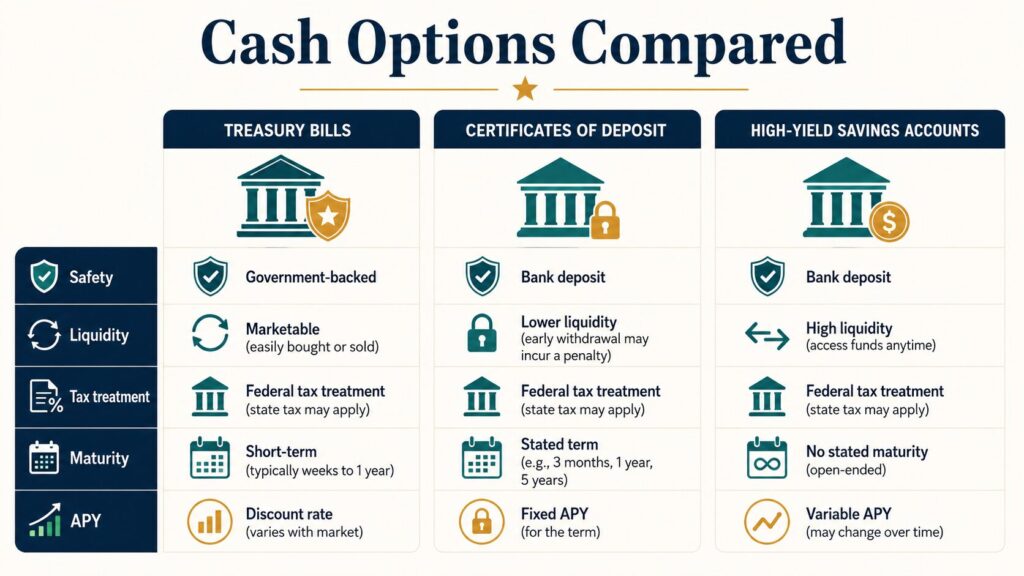
Treasury bills vs CDs is a comparison between short-term U.S. government securities and fixed-term bank deposit products.
A Treasury bill, often called a T-bill, is a short-term U.S. Treasury security. Bills are sold at a discount or at par, and when the bill matures, you receive its face value. TreasuryDirect says regular Treasury bills mature in 4, 6, 8, 13, 17, 26, and 52 weeks, with interest paid at maturity.
A CD, or certificate of deposit, is a bank or credit union deposit account that usually pays a fixed APY for a set term. If you withdraw early, you may owe an early-withdrawal penalty.
A savings account, especially a high-yield savings account, is usually more flexible. Its APY can change, but you can generally access the money more easily than with a CD or T-bill.
| Feature | Treasury bills | CDs | Savings accounts |
|---|---|---|---|
| What it is | U.S. Treasury security | Bank or credit union time deposit | Bank or credit union deposit account |
| Typical use | Planned short-term cash | Known-date savings | Emergency and flexible cash |
| Rate type | Fixed at auction | Usually fixed for term | Usually variable |
| Access | Hold to maturity or sell before maturity | Hold to maturity or pay penalty | Flexible transfers |
| Main benefit | Government-backed short-term yield | Fixed APY and deposit insurance if eligible | Liquidity |
| Main drawback | Less convenient access than savings | Early-withdrawal penalty | APY can fall |
| Best for | Cash you can set aside for weeks or months | Cash with a known date | Cash you may need anytime |
What Is a Treasury Bill?
A Treasury bill is a short-term debt security issued by the U.S. Treasury. Instead of paying regular interest like many bonds, a T-bill is commonly bought for less than its face value and pays the full face value at maturity.
For example, you might buy a $1,000 T-bill for less than $1,000. At maturity, you receive $1,000. The difference is your interest.
Treasury bills can be purchased through TreasuryDirect, banks, brokers, or dealers. Many investors use them for short-term cash because the maturities are short and the credit backing is strong.
T-bills can work well for:
- Cash needed in a few weeks or months
- Tax reserves
- Down-payment cash with a known timeline
- Conservative short-term savings
- Larger balances that exceed bank-insurance limits
- Savers who want to avoid state and local income tax on Treasury interest
T-bills are not the same as savings accounts. They are securities, not bank deposits.
What Is a CD?
A certificate of deposit is a time deposit at a bank or credit union. You agree to leave money in the CD for a term, and the institution usually agrees to pay a fixed APY for that term.
Common CD terms include a few months to several years, depending on the institution. A CD can be useful when you know exactly when you will need the money.
CDs can work well for:
- Tuition due next semester
- Property taxes due in six months
- A car purchase fund
- A wedding fund
- A home project with a fixed date
- Extra cash beyond your emergency fund
- Savers who want a fixed APY
The biggest downside is access. If you need the money before maturity, the bank may charge an early-withdrawal penalty. Some CDs have special structures, such as no-penalty CDs or bump-up CDs, but the terms vary.
If the main decision is whether to lock a CD rate now, TFO’s guide on whether to lock in a CD rate explains the rate-timing tradeoff.
What Is a High-Yield Savings Account?
A high-yield savings account is a savings account that pays a more competitive APY than many traditional bank savings accounts. It is often the simplest place to keep emergency savings and flexible short-term cash.
Savings accounts can work well for:
- Emergency funds
- Medical deductibles
- Job-loss backup
- Home and car repairs
- Cash you may need quickly
- Goals with uncertain dates
- Money you are not ready to lock
The main benefit is liquidity. The main drawback is that the APY is usually variable. If market rates fall or your bank changes its pricing, your APY may drop.
If you want a cash option that keeps emergency money accessible, TFO’s high-yield savings account guide explains what to compare before opening one.
Safety: Which One Is Safer?
Treasury bills, CDs, and savings accounts can all be considered conservative cash options, but they are protected in different ways.
At FDIC-insured banks, savings accounts and CDs are covered deposit products, while U.S. Treasury bills, bonds, and notes are not FDIC-covered bank deposits. FDIC coverage generally depends on whether the product is a deposit product and whether the bank is FDIC-insured.
That does not mean Treasury bills are unsafe. It means they are not bank deposits. They are obligations of the U.S. Treasury.
| Safety factor | Treasury bills | CDs | Savings accounts |
|---|---|---|---|
| FDIC or NCUA insurance | No | Yes, if eligible and within limits | Yes, if eligible and within limits |
| Backing | U.S. Treasury | Bank or credit union deposit insurance if eligible | Bank or credit union deposit insurance if eligible |
| Market value risk | Possible if sold before maturity | Usually none if held to terms | No market value fluctuation |
| Access risk | Cash tied up until maturity unless sold | Early-withdrawal penalty may apply | Usually easiest access |
| Main safety check | Buy and hold to matching maturity | Verify insured institution and limits | Verify insured institution and limits |
For emergency money, safety is not only about credit risk. It is also about access.
Liquidity: Which Option Gives You Cash Fastest?
Liquidity is where savings accounts usually win.
A savings account usually lets you transfer money to checking, although transfer speed depends on the bank. A CD usually locks money until maturity unless you accept a penalty. A Treasury bill pays at maturity, though you may be able to sell it before maturity through a brokerage.
| Need for cash | Best fit | Why |
|---|---|---|
| Same-day or next-day emergency | Checking or linked savings | Fastest access |
| Emergency fund | High-yield savings | Liquid and still earns interest |
| Known expense in 3 months | T-bill, CD, or savings | Match access to the date |
| Known expense in 12 months | T-bill, CD, or ladder | Fixed timeline helps |
| Cash you may need at any time | Savings account | Avoid maturity and penalty issues |
A higher yield is not worth much if you cannot access the money when life breaks the plan.
If you are still deciding how much cash needs to remain liquid, TFO’s guide to how much emergency fund can help you set the baseline.
Taxes: Treasury Bills Have a Key Advantage
Treasury bills have one tax feature that can matter: Treasury interest is generally subject to federal income tax but exempt from state and local income taxes. CDs and savings account interest are generally taxable at the federal level and may also be taxable at the state and local level.
That can make T-bills more attractive for savers in higher-tax states.
Here is a simplified comparison:
| Product | Federal tax | State and local tax | Tax note |
|---|---|---|---|
| Treasury bills | Generally taxable | Generally exempt | Useful in higher-tax states |
| CDs | Generally taxable | Generally taxable | Bank reports interest |
| Savings accounts | Generally taxable | Generally taxable | Bank reports interest |
Tax rules can change, and your situation may vary. Use after-tax yield when comparing options, not just headline APY.
Rate Risk: Fixed, Variable, and Reinvestment Risk
Each option handles rate changes differently.
Treasury bills
T-bills lock the rate for the bill’s term. If rates fall after you buy, your existing bill keeps its auction yield if held to maturity. If rates rise, you may wish you had waited or chosen a shorter term.
When a T-bill matures, you face reinvestment risk. That means the next bill may pay less than the one that just matured.
CDs
CDs usually lock the APY for the term. That can be useful if rates fall. It can be frustrating if rates rise or if you need cash early.
Savings accounts
Savings accounts usually have variable APYs. They can rise when banks compete for deposits, but they can also fall quickly when rates decline or a promotional offer ends.
| Rate scenario | Treasury bills | CDs | Savings accounts |
|---|---|---|---|
| Rates rise | New bills may pay more | Existing CD may lag | APY may rise, but not guaranteed |
| Rates fall | Existing bill keeps term yield | Existing CD keeps fixed APY | APY may fall |
| Rates are uncertain | Laddering can help | CD ladder can help | Flexibility helps |
| You need certainty | Good for short terms | Good if term fits | Less certain |
The best choice depends less on predicting rates and more on matching the maturity to your cash need.
Treasury Bills vs CDs: Which Pays More?
There is no permanent winner. Sometimes T-bills pay more. Sometimes CDs pay more. Sometimes a high-yield savings account is close enough that liquidity matters more than the yield gap.
The correct comparison is not just APY. Compare:
- T-bill yield after state tax benefits
- CD APY after early-withdrawal risk
- Savings APY after possible rate changes
- Fees and minimums
- Access timing
- Your actual goal date
A CD paying slightly more than a savings account may not be worth it if the money is emergency cash. A T-bill paying slightly more than a CD may not be worth it if you do not understand how to buy, hold, sell, or reinvest it.
Example: $25,000 in T-Bills, CDs, or Savings
Assume you have $25,000 of short-term cash.
| Option | Example APY or yield | Estimated 1-year interest | Best if |
|---|---|---|---|
| High-yield savings | 4.00% variable | About $1,000 if APY holds | You need flexibility |
| 12-month CD | 4.25% fixed | About $1,063 if held to maturity | You know you will not need the money |
| T-bill ladder | 4.20% average yield | About $1,050 before taxes | You want short maturities and state-tax benefit |
This is a simplified example, not a rate quote. Actual earnings depend on current rates, compounding, auction results, taxes, fees, timing, and whether you withdraw or sell early.
The lesson is that a small yield difference may not justify giving up liquidity. On $25,000, a 0.25 percentage-point difference is about $62.50 per year before taxes. For emergency cash, flexibility may be worth more than that.
A compound interest calculator can help estimate the dollar difference using your own balance and rate assumptions.
Which Option Is Best for an Emergency Fund?
A high-yield savings account is usually best for an emergency fund because access matters most.
Emergency money should cover surprise expenses such as:
- Job loss
- Medical bills
- Car repairs
- Home repairs
- Urgent travel
- Insurance deductibles
- Temporary income gaps
A CD can be used for extra reserves beyond your main emergency fund, but it should not hold the first layer of emergency cash. A T-bill ladder can work for advanced cash management, but it is usually not the simplest emergency-fund option for beginners.
A practical emergency setup:
| Emergency layer | Best place | Reason |
|---|---|---|
| First 2–4 weeks of expenses | Checking or linked savings | Immediate access |
| Main emergency fund | High-yield savings | Safety plus liquidity |
| Extra reserve | Short CD or T-bill ladder | Higher yield with staggered access |
If you are still building the fund, start with TFO’s guide to build an emergency fund before optimizing the last decimal of APY.
Which Option Is Best for a Known Future Expense?
For a known expense, CDs and T-bills become more attractive.
Examples include:
- Property taxes due in six months
- Tuition due next semester
- A home project deposit
- A car purchase in nine months
- A wedding bill with a fixed date
- A tax bill due by a deadline
The key is matching maturity to the date you need the money.
| Goal date | Strong options | Avoid |
|---|---|---|
| Under 30 days | Checking or savings | CD or T-bill that matures too late |
| 1–3 months | Savings or short T-bill | Long CD |
| 3–12 months | T-bill, CD, or savings | Stock-market risk |
| 1–2 years | CD ladder, T-bill ladder, savings mix | Locking everything without liquidity |
| 5+ years | Consider investments after cash needs | Excess idle cash without purpose |
For a goal with a specific dollar amount and deadline, a savings goal calculator can help estimate how much to save each month.
Treasury Bill Ladder vs CD Ladder
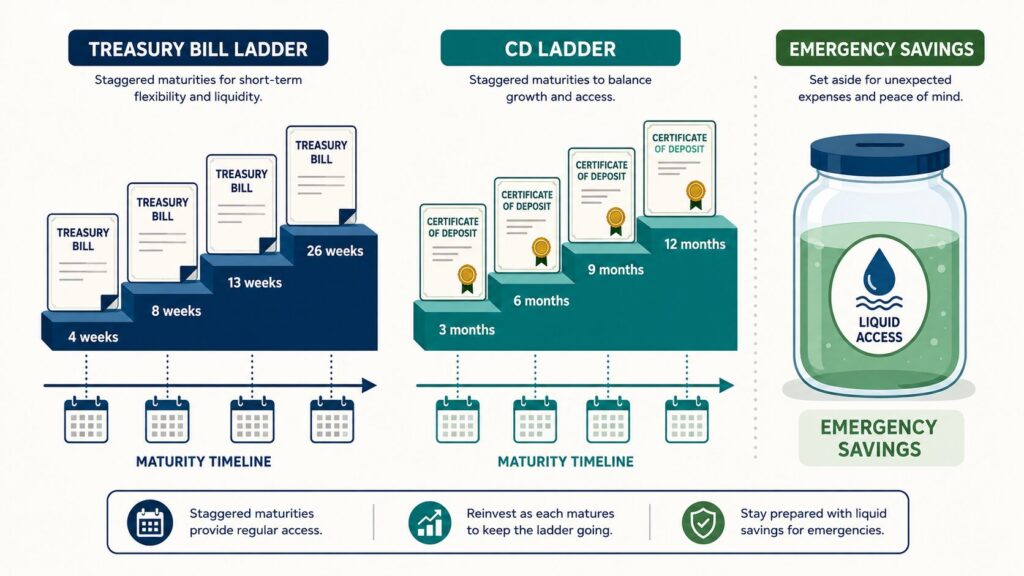
A ladder spreads money across multiple maturities. It reduces the risk of locking everything at the wrong time or needing cash before everything matures.
Treasury bill ladder example
| Rung | Term | Purpose |
|---|---|---|
| Rung 1 | 4 weeks | Frequent liquidity |
| Rung 2 | 8 weeks | Short-term yield |
| Rung 3 | 13 weeks | Quarterly access |
| Rung 4 | 26 weeks | Longer short-term yield |
CD ladder example
| Rung | Term | Purpose |
|---|---|---|
| Rung 1 | 3 months | Near-term access |
| Rung 2 | 6 months | Medium-term cash |
| Rung 3 | 9 months | Staggered maturity |
| Rung 4 | 12 months | Longer rate lock |
A T-bill ladder can be appealing for short-term cash, especially in states with income tax. A CD ladder can be simpler for savers who prefer bank products and fixed APYs.
Neither ladder should replace the first layer of emergency cash.
Treasury Bills vs CDs vs Savings: Best Use Cases
| Situation | Best option | Why |
|---|---|---|
| You may need money tomorrow | Savings or checking | Fast access |
| You are building an emergency fund | High-yield savings | Simple and liquid |
| You have a bill due in 13 weeks | T-bill or savings | Short maturity can match date |
| You have cash due in 12 months | CD, T-bill, or ladder | Known timeline |
| You live in a high-tax state | T-bill may be attractive | State/local tax exemption can help |
| You want no auction mechanics | CD or savings | Simpler bank experience |
| You want the simplest option | High-yield savings | Easy to open and manage |
| You want a fixed bank APY | CD | Rate certainty |
| You have more than insured limits | T-bills or multiple insured banks | Spread risk carefully |
The best choice is often a mix, not a single winner.
How to Choose in 5 Steps
Step 1: Label the cash
Write down what the money is for: emergency fund, taxes, down payment, tuition, car replacement, insurance deductible, or general savings.
Step 2: Set the deadline
Money needed soon should stay liquid. Money with a fixed date can use a maturity product.
Step 3: Check safety
For savings and CDs, verify the bank or credit union and coverage limits. For T-bills, understand that you are buying a Treasury security, not opening a bank deposit.
Step 4: Compare after-tax yield
Do not compare only headline rates. For T-bills, consider the state and local tax exemption. For CDs and savings, consider federal, state, and local taxes.
Step 5: Protect access
Do not chase a slightly higher yield if it creates a cash-flow problem. The right account should work even when life is inconvenient.
When Treasury Bills May Win
Treasury bills may be the best choice when:
- You have a known short-term timeline
- You can hold to maturity
- You want U.S. Treasury backing
- You live in a state with income tax
- You are comfortable using TreasuryDirect or a brokerage
- You want a ladder with short maturities
- Your balance exceeds bank-insurance limits and you want another cash-management tool
T-bills may not be ideal if you need instant access or do not want to manage auctions, maturity dates, or reinvestments.
When CDs May Win
CDs may be the best choice when:
- You want a fixed APY
- The term matches your goal date
- The institution is federally insured
- You understand the early-withdrawal penalty
- You prefer bank products
- You want a simple maturity date
- The CD APY is meaningfully better than savings
CDs may not be ideal for emergency money, uncertain timelines, or savers who may need the cash early.
When Savings Accounts May Win
Savings accounts may be the best choice when:
- You are building an emergency fund
- You may need the cash suddenly
- Your goal date is flexible
- The APY is competitive
- You want simple transfers
- You do not want maturity dates
- You are still deciding what to do with the money
Savings accounts may not lock a rate, but that flexibility can be more valuable than a small yield advantage elsewhere.
If your broader question is where to keep cash during high rates, TFO’s guide on where to keep cash when rates are high compares common cash buckets by timeline.
Common Mistakes
Treating all cash options as the same
Treasury bills, CDs, and savings accounts can all be conservative, but they are not identical. They differ by access, insurance, taxes, maturity, and rate behavior.
Putting emergency money in a long CD
A CD may pay more, but emergency cash needs access. Do not lock up money you may need for a job loss, repair, or medical bill.
Buying T-bills without understanding maturity
A T-bill is not a checking account. Make sure the maturity date matches when you need the money.
Comparing pre-tax yields only
Treasury bills may have a state and local tax advantage. CDs and savings interest may be taxed differently. Compare after-tax results when the difference matters.
Ignoring early-withdrawal penalties
A CD’s headline APY can look attractive until you need the money early. Always read the penalty before opening.
Forgetting renewal and reinvestment dates
CDs can renew automatically. T-bills can mature and leave cash idle if you do not reinvest. Set reminders.
Chasing yield with money that should reduce debt
If you carry high-interest credit-card debt, the interest cost may exceed what any safe cash option pays. A credit-card payoff calculator can show whether extra cash should go toward debt first.
Quick Summary
- Treasury bills vs CDs is a comparison between U.S. Treasury securities and bank time deposits.
- Savings accounts are usually best for emergency cash because they are the most flexible.
- CDs can be useful for known-date savings when you want a fixed APY and can avoid early withdrawal.
- Treasury bills can be attractive for short-term cash, especially because Treasury interest is generally exempt from state and local income taxes.
- T-bills are not FDIC-insured bank deposits; CDs and savings accounts can be insured when held at eligible institutions and within limits.
- The best choice depends on your timeline, liquidity needs, taxes, and comfort with maturity dates.
- Many savers should use a mix: savings for emergencies, CDs or T-bills for planned cash, and investments for long-term goals.
Frequently Asked Questions
Are Treasury bills better than CDs?
Treasury bills can be better for short-term cash if you want U.S. Treasury backing, short maturities, and possible state and local tax advantages. CDs can be better if you prefer insured bank deposits, fixed APYs, and simple terms.
Are CDs safer than Treasury bills?
They are safe in different ways. CDs at federally insured banks or credit unions can have deposit insurance within applicable limits. Treasury bills are U.S. Treasury securities, not bank deposits, and are not FDIC-insured.
Are Treasury bills better than savings accounts?
Treasury bills may pay a competitive yield and offer tax advantages, but savings accounts are more flexible. For emergency money, savings accounts usually fit better. For planned short-term cash, T-bills may be worth comparing.
Are Treasury bills FDIC insured?
No. Treasury bills are not FDIC-insured bank deposits. They are securities issued by the U.S. Treasury.
Should I keep my emergency fund in Treasury bills?
Usually not the first layer. Keep immediate emergency cash in checking or high-yield savings. You can consider a short T-bill ladder only for extra reserves after your liquid emergency fund is already in place.
Should I choose a CD or savings account?
Choose savings if you need flexibility. Choose a CD if the money has a fixed future date, the APY is attractive, and you are comfortable leaving the money until maturity.
Can I lose money on Treasury bills?
If you buy a T-bill and hold it to maturity, you receive the face value. If you sell before maturity through a brokerage, the price can move, so the result may differ from holding to maturity.
Build a Cash Map Before Choosing a Product
Do not start with the highest advertised yield. Start with the job of the money. Keep emergency cash in savings, match CDs or Treasury bills to known dates, and avoid locking up money you may need suddenly. The best cash strategy is the one that still works if rates change, bills arrive early, or life interrupts your plan.
Reviewed by: The Finance Orbit Editorial Team
Reviewed and updated: July 19, 2026
This article is for general educational and informational purposes only and does not constitute financial, investment, tax, legal, insurance, or credit advice. Products, rates, laws, limits, eligibility rules, and terms can change. Verify current information and consult a qualified professional for advice specific to your circumstances.