Quick Answer: Where to keep cash when rates are high depends on when you need the money. Keep bill money in checking, emergency cash in a federally insured high-yield savings or money market deposit account, and cash you will not need for several months in CDs or Treasury bills. Do not chase the highest yield without checking access, insurance, penalties, taxes, and whether the product is a deposit account or an investment.
High interest rates can be good news for savers, but only if cash is parked in the right place. Money sitting in a low-yield checking account may earn almost nothing while safer alternatives pay more. The challenge is not finding the highest advertised rate. It is matching each dollar to the right mix of safety, liquidity, and yield.
Where to Keep Cash When Rates Are High
The best answer to where to keep cash when rates are high is to split your money by purpose.
Cash you need this month belongs in checking. Emergency savings usually belong in a high-yield savings account or money market deposit account. Cash for a known goal a few months away may fit in a certificate of deposit or Treasury bills. Long-term money you do not need for years may not belong in cash at all.
Here is the simplest cash map:
| Cash purpose | Best place to consider | Why it fits |
|---|---|---|
| Bills due in 0–30 days | Checking account | Fast access and automatic payments |
| Emergency fund | High-yield savings account or money market account | Safety, liquidity, and competitive interest |
| Goal in 3–12 months | High-yield savings, Treasury bills, or short CDs | Better yield without taking stock-market risk |
| Goal in 1–3 years | CD ladder, Treasury ladder, or high-yield savings | Balances yield and access dates |
| Money needed in 5+ years | Usually investments, not cash | Cash may lose purchasing power after inflation |
The point is not to pick one account for everything. The safest strategy is usually a layered cash system.
Best Places to Keep Cash When Interest Rates Are High
1. High-Yield Savings Account
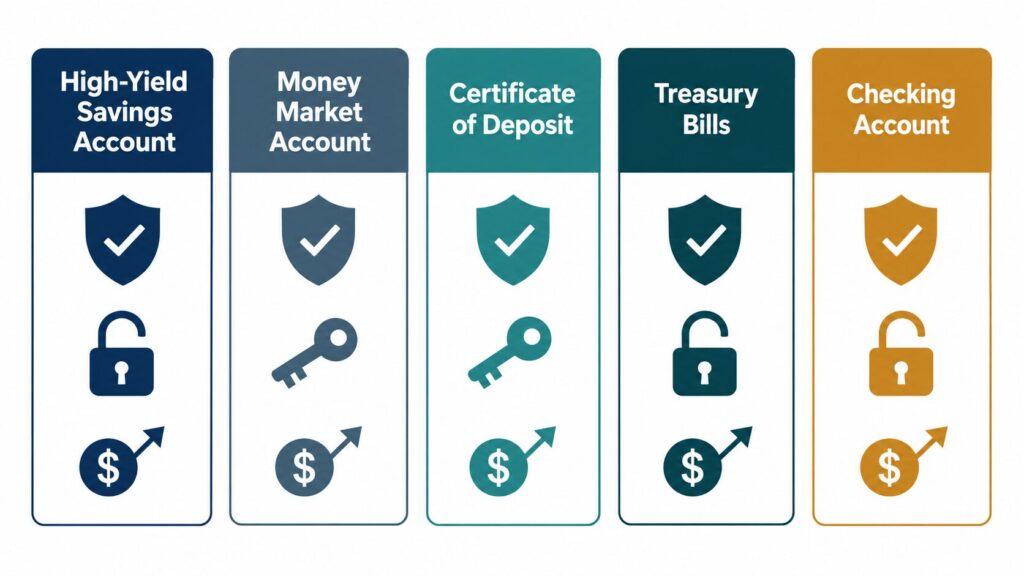
A high-yield savings account is often the best default place for emergency cash and short-term savings. It can pay much more than a traditional savings account while keeping your money accessible.
A high-yield savings account works well for:
- Emergency funds
- Home repair savings
- Medical deductibles
- Tax money due soon
- Travel or wedding savings
- Cash you may need within a few months
The main advantage is flexibility. You can usually transfer money back to checking when needed, although transfers may take one to three business days depending on the bank.
The main downside is rate risk. Savings APYs are variable, so a strong rate today can fall if market rates decline. That is not a reason to avoid high-yield savings. It is a reason not to assume the current APY is permanent.
If you are opening one for the first time, The Finance Orbit’s guide to a high-yield savings account explains what to compare before moving money.
2. Money Market Deposit Account
A money market account at a bank or credit union can be a good place for cash when you want a savings-like APY plus more access features.
Money market deposit accounts may offer:
- Competitive interest
- Debit card access
- Check-writing privileges
- ATM access
- FDIC or NCUA insurance when held at an insured institution
This can make a money market account useful for larger emergency funds, property-tax reserves, quarterly tax payments, or cash you may need to access quickly.
Do not confuse a money market deposit account with a money market fund. A bank money market deposit account is a deposit product. A money market fund is an investment product.
3. Certificate of Deposit
A certificate of deposit can make sense when rates are high and you are willing to lock up money for a specific term. CDs usually pay a fixed APY for a fixed period, such as 3 months, 6 months, 12 months, or longer.
CDs are useful when:
- You know you will not need the money before maturity
- You want to lock in a rate
- You are saving for a known date
- You want predictable interest
- You are not comfortable with market risk
The main downside is the early-withdrawal penalty. If you break the CD early, you may lose some interest. That is why CDs are usually a poor place for your entire emergency fund.
A better strategy is to keep immediate emergency cash in savings and use CDs only for the portion you can truly leave untouched. If you are deciding whether to lock in a rate now, this guide on whether to lock in a CD rate can help you weigh the tradeoff.
4. Treasury Bills
Treasury bills, often called T-bills, are short-term U.S. government securities. They can be attractive when short-term rates are high because they are backed by the U.S. government and commonly mature in weeks or months.
Treasury bills may fit:
- Cash you do not need immediately
- Short-term goals with a known date
- Large balances where bank-insurance limits matter
- Savers comfortable using TreasuryDirect or a brokerage account
- People who want state and local tax advantages on Treasury interest
The tradeoff is access. A Treasury bill is not the same as a checking account. If you buy directly and hold to maturity, your cash is tied up until the bill matures. If you buy through a brokerage and sell before maturity, the price can move.
Treasury bills can be excellent cash-management tools, but they are not a substitute for instant emergency access.
5. Money Market Fund
A money market fund is a mutual fund that invests in short-term, high-quality instruments. It is often used inside brokerage accounts as a place to hold uninvested cash.
Money market funds may offer competitive yields when rates are high, but they are not bank deposits. They are investment products, and they are not FDIC-insured. The SEC’s Investor.gov explains that money market funds invest in short-term debt securities, cash, and cash equivalents, and that they do not carry FDIC deposit insurance.
That distinction matters. A money market fund may be reasonable for brokerage cash, but an emergency fund should be held where you understand the risks, access rules, and protections.
6. Checking Account
A checking account is not usually the best place to earn interest, but it is still important.
Keep enough in checking for:
- Monthly bills
- Automatic payments
- Rent or mortgage
- Utilities
- Insurance premiums
- Groceries and gas
- A small buffer to avoid overdrafts
Checking is for cash flow, not yield. If you keep too much there, you may miss out on interest. If you keep too little, you may trigger overdrafts, late payments, or transfer stress.
A practical rule: keep one month of bills plus a small cushion in checking, then move extra cash to a higher-yield option.
Cash Safety: What “Safe” Really Means
Safe cash has two parts: principal protection and access.
At insured banks, FDIC coverage generally protects eligible deposit accounts such as checking accounts, savings accounts, money market deposit accounts, and CDs up to applicable limits. Credit unions have similar federal protection through the NCUA.
But not everything that feels like cash has the same protection.
| Product | Bank deposit? | Usually insured by FDIC or NCUA? | Can lose market value? | Best use |
|---|---|---|---|---|
| Checking account | Yes | Yes, if institution is insured | No | Monthly bills |
| High-yield savings account | Yes | Yes, if institution is insured | No | Emergency savings |
| Money market deposit account | Yes | Yes, if institution is insured | No | Flexible cash reserves |
| Certificate of deposit | Yes | Yes, if institution is insured | No, if held to maturity; early-withdrawal penalties may apply | Known-date savings |
| Treasury bills | No | No FDIC insurance | Possible if sold early | Short-term government-backed cash |
| Money market fund | No | No | Low risk, but not guaranteed | Brokerage cash |
Before moving money, verify whether the product is a deposit account, a Treasury security, or an investment product. The name can sound similar while the protections are different.
High Rates Create a Cash Opportunity Cost
When interest rates are low, leaving extra money in checking may not feel costly. When rates are high, the opportunity cost becomes obvious.
Here is a simple example using $20,000 of cash:
| APY | Estimated interest after 1 year |
|---|---|
| 0.01% | $2 |
| 1.00% | $200 |
| 3.50% | $700 |
| 4.00% | $800 |
| 4.50% | $900 |
This example is simplified and assumes the APY is maintained for a full year. Actual earnings can vary if rates change, deposits move, or interest compounds differently.
Still, the lesson is clear. High-rate environments reward people who organize cash instead of leaving everything idle.
If you want to test different balances and APYs, a compound interest calculator can show how much your cash may earn over time.
The Best Cash Strategy by Time Horizon
The right place for cash depends mostly on when you need it.
Cash needed this month
Use checking. The goal is smooth payments, not maximum yield.
Cash needed in 1–3 months
Use a high-yield savings account or money market deposit account. You want quick access and safety.
Cash needed in 3–12 months
Use high-yield savings, Treasury bills, or short CDs. Do not take stock-market risk with money you need soon.
Cash needed in 1–3 years
Consider a CD ladder, Treasury ladder, or a mix of high-yield savings and fixed-rate CDs. The goal is to earn more while matching maturity dates to your planned expenses.
Cash not needed for 5+ years
Consider whether it should be invested instead of held in cash. Cash can feel safe, but over long periods inflation can reduce purchasing power.
If you are deciding whether to keep building cash or start investing, emergency fund vs. investing comparison can help you set the right order.
Emergency Fund: Do Not Lock Up the Whole Thing
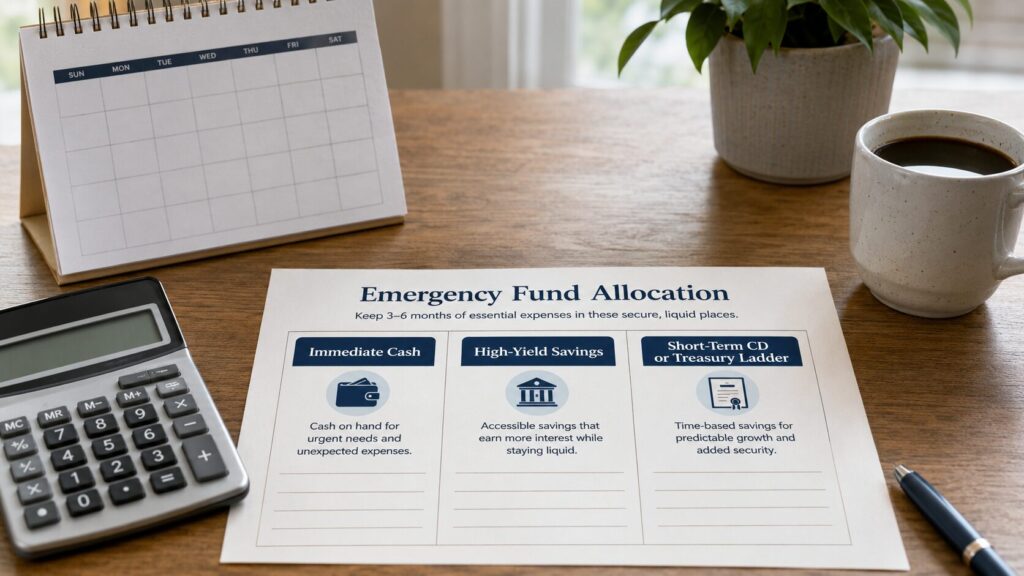
High rates can make CDs and Treasury bills tempting, but your emergency fund needs liquidity first.
A good structure is:
| Emergency fund layer | Where to keep it | Purpose |
|---|---|---|
| First 2–4 weeks of expenses | Checking or linked savings | Immediate access |
| Next 2–3 months of expenses | High-yield savings or money market account | Main emergency cushion |
| Extra reserves | Short CDs or Treasury bills | Higher yield with planned maturity dates |
This keeps your emergency fund useful. A high APY does not help much if you cannot access the money during a job loss, medical bill, car repair, or home emergency.
If you are unsure how large your cash reserve should be, start with guide to how much emergency fund you may need based on your household risk.
Should You Lock In a CD When Rates Are High?
A CD is most useful when you want certainty. If rates fall after you open the CD, your rate stays locked for the term. If rates rise, you may be stuck earning less than new CDs offer unless you accept an early-withdrawal penalty.
Use a CD when:
- The money has a clear future date
- The rate is meaningfully better than savings
- The penalty is reasonable
- The bank or credit union is insured
- You do not need daily access
Avoid putting all cash in one long CD. A ladder can reduce timing risk.
Simple CD ladder example
| CD | Term | Purpose |
|---|---|---|
| CD 1 | 3 months | Near-term cash |
| CD 2 | 6 months | Medium-term cash |
| CD 3 | 9 months | Later goal |
| CD 4 | 12 months | Rate lock |
As each CD matures, you can use the money, renew it, or move it back to savings depending on rates and your needs.
Should You Use Treasury Bills Instead of a Savings Account?
Treasury bills can be attractive, but they are not always better than savings.
Consider Treasury bills when:
- You are comfortable with TreasuryDirect or a brokerage
- You can hold until maturity
- You want short maturities
- You are managing a larger cash balance
- You understand the tax reporting
Use a savings account instead when:
- You may need the money suddenly
- You want simple transfers
- You do not want auction dates or brokerage mechanics
- You are building your first emergency fund
- You need predictable access more than a slightly higher yield
Treasury bills are best for planned cash. Savings accounts are best for flexible cash.
What About Cash in a Brokerage Account?
Brokerage cash can be convenient if you invest regularly. But cash in a brokerage sweep program, money market fund, or settlement account may have different protections and yields.
Check:
- Is the cash swept into FDIC-insured partner banks?
- Is it held in a money market fund?
- What is the current yield?
- Are there fees?
- How quickly can you transfer money out?
- What happens if the brokerage changes the sweep option?
Do not assume all “cash” inside a brokerage account is protected the same way as cash in a bank savings account.
How Much Cash Should Stay in Checking?
Keep enough in checking to avoid cash-flow problems, but not so much that you miss out on interest.
A practical checking target is:
One month of bills + upcoming automatic payments + a small buffer
For example:
| Monthly item | Amount |
|---|---|
| Rent or mortgage | $1,800 |
| Utilities | $250 |
| Insurance | $180 |
| Groceries and gas | $700 |
| Debt minimums | $300 |
| Buffer | $500 |
| Suggested checking balance | $3,730 |
In this example, cash above the checking target could move to high-yield savings, a money market account, CDs, or Treasury bills depending on timing.
If you struggle to separate bills from savings, money management for beginners guide can help organize checking, savings, debt, and flexible spending.
A Simple High-Rate Cash Plan
Use this framework before moving money.
Step 1: Label every dollar
Give each cash bucket a job: bills, emergency fund, taxes, down payment, tuition, travel, insurance deductible, or long-term investing.
Step 2: Match the timeline
Do not put short-term cash in long-term products. Do not keep long-term money in low-yield cash without a reason.
Step 3: Check safety
Confirm whether the product is insured, government-backed, or an investment. Similar names can create very different risks.
Step 4: Compare net yield
Look at APY, fees, minimums, early-withdrawal penalties, state taxes, and transfer speed. The highest headline rate is not always the best deal.
Step 5: Avoid over-optimization
Moving money every week to chase a tiny APY difference can create transfer delays and mistakes. Pick a strong, safe setup and review it monthly or quarterly.
Where Not to Keep Important Cash
High rates can attract risky alternatives that market themselves as cash substitutes. Be cautious with:
- Uninsured fintech balances where the partner bank is unclear
- Crypto yield products
- Stablecoins
- Long-term bond funds for short-term cash
- Stock funds for money needed soon
- Promotional accounts with confusing requirements
- Accounts with high fees that erase the APY
- Products you do not understand
Emergency money should be boring. The purpose is to be there when life breaks the plan.
How High Interest Rates Affect Your Decision
When rates are high, savers have more choices. But each option responds differently when rates change.
| Product | If rates rise | If rates fall |
|---|---|---|
| High-yield savings | APY may rise, but not guaranteed | APY may fall |
| Money market account | APY may rise, but not guaranteed | APY may fall |
| CD | Existing rate stays fixed | Existing rate stays fixed |
| Treasury bill | New bills may pay more | New bills may pay less |
| Money market fund | Yield may adjust with short-term rates | Yield may decline |
Variable-rate accounts are flexible but can reprice quickly. Fixed-rate CDs lock the rate but reduce flexibility. Treasury bills offer defined maturities but require more planning.
If Fed decisions are affecting your savings and debt choices, The Finance Orbit’s guide on how interest rates work explains why savings rates, credit-card rates, mortgages, and Treasury yields do not all move the same way.
Best Overall Setup for Most Savers
For many households, the best high-rate cash setup looks like this:
| Bucket | Account type | Goal |
|---|---|---|
| Bill money | Checking | Fast payments |
| First emergency layer | Linked savings | Immediate backup |
| Main emergency fund | High-yield savings or money market account | Safety and liquidity |
| Known 6–12 month goal | CD or Treasury bill | Higher yield with maturity date |
| Long-term surplus | Investment account | Growth potential |
This setup avoids two common extremes: leaving everything in checking or locking everything into CDs.
Common Mistakes
Chasing the highest APY without checking insurance
A high rate is not enough. Confirm whether the account is FDIC-insured or NCUA-insured, and understand coverage limits.
Confusing money market accounts and money market funds
A money market deposit account at an insured bank is different from a money market mutual fund in a brokerage account. The names sound similar, but the protections are not the same.
Locking up emergency cash in CDs
A CD can be safe and useful, but it is not ideal for money you may need tomorrow. Keep immediate emergency cash liquid.
Keeping too much in checking
Checking is convenient, but excess idle cash can miss meaningful interest when rates are high.
Ignoring taxes
Interest from savings accounts, CDs, money market accounts, and Treasury bills is generally taxable at the federal level. Treasury interest may have different state and local tax treatment. Tax rules can change, so verify before making large moves.
Forgetting that rates can fall
High-yield savings and money market account rates are variable. A strong APY today may not last.
Investing short-term cash in stocks
Money needed within the next few months or years should not depend on the stock market cooperating at the exact time you need it.
Quick Summary
- Where to keep cash when rates are high depends on when you need the money.
- Checking is best for monthly bills, not excess savings.
- A high-yield savings account is often the best default for emergency funds and flexible short-term cash.
- A money market account can work well when you want interest plus limited spending access.
- A certificate of deposit can lock in a rate, but early withdrawals may trigger penalties.
- Treasury bills can be useful for planned short-term cash, but they are not instant-access emergency money.
- The best strategy is usually a cash ladder that balances safety, liquidity, and yield.
Frequently Asked Questions
Where is the best place to keep cash when rates are high?
For most people, the best place is a mix of checking, high-yield savings, and possibly CDs or Treasury bills. Checking handles bills, high-yield savings handles emergency cash, and CDs or Treasury bills can fit money with a known future date.
Is a high-yield savings account safe?
Yes, if it is held at an FDIC-insured bank or NCUA-insured credit union and your balance stays within applicable coverage limits. Always verify the actual institution holding the deposits.
Are CDs better than savings accounts when rates are high?
CDs can be better if you want to lock in a rate and do not need the money before maturity. Savings accounts are better for emergency money because they are more liquid and do not usually have early-withdrawal penalties.
Are Treasury bills good for cash savings?
Treasury bills can be good for planned short-term cash because they are U.S. government securities and have defined maturities. They are not ideal for money you may need immediately.
Should I keep my emergency fund in a CD?
Do not keep the entire emergency fund in a CD. Keep the first layer in checking or high-yield savings, then consider CDs only for extra reserves you can leave untouched.
Is a money market account the same as a money market fund?
No. A money market account is usually a bank or credit union deposit account. A money market fund is an investment product, usually held through a brokerage or mutual fund company.
How often should I move cash to chase better rates?
Review rates every few months, not every few days. Moving money for tiny differences can create delays, paperwork, and mistakes. Move only when the rate gap is meaningful and the new account is safe, low-fee, and easy to use.
Build Your Cash Ladder Before Rates Change
Start with your timeline. Keep bill money in checking, emergency money in high-yield savings or a money market account, and planned cash in CDs or Treasury bills only when the maturity date fits. Once every dollar has a job, you can earn more interest without turning safe cash into a risky guessing game.
Reviewed by: The Finance Orbit Editorial Team
Reviewed and updated: July 19, 2026
This article is for general educational and informational purposes only and does not constitute financial, investment, tax, legal, insurance, or credit advice. Products, rates, laws, limits, eligibility rules, and terms can change. Verify current information and consult a qualified professional for advice specific to your circumstances.