Quick Answer: CPI vs PCE comes down to how each inflation measure tracks prices, spending, and consumer behavior. CPI is better known because it reflects the prices consumers pay directly for a basket of goods and services. PCE is broader, adjusts more quickly when consumers change what they buy, and is the inflation measure the Federal Reserve uses for its 2% longer-run inflation target.
When inflation is in the news, most headlines lead with CPI. When the Federal Reserve talks about its official inflation target, it usually focuses on PCE. That can confuse consumers because both numbers describe inflation, but they are not built the same way and they do not always send the same signal.
CPI vs PCE: The Core Difference
CPI vs PCE is a comparison between two major U.S. inflation measures: the Consumer Price Index and the Personal Consumption Expenditures price index.
CPI measures price changes for a basket of goods and services purchased directly by urban consumers. It is the inflation number most people recognize because it is widely reported in the news and closely tied to cost-of-living conversations.
PCE inflation measures price changes across a broader range of consumer spending, including some spending done on behalf of households, such as employer-paid or government-paid medical costs. It also adjusts more naturally when people change their buying habits.
The Federal Reserve says it seeks 2% inflation over the longer run as measured by the annual change in the PCE price index, and it notes that PCE adapts more quickly to changes in spending patterns than CPI.
What Is CPI Inflation?
CPI inflation tracks the average change over time in prices paid by consumers for a representative basket of goods and services. That basket includes categories such as housing, food, energy, transportation, medical care, apparel, recreation, and education.
CPI is especially useful for understanding the prices consumers feel directly. If rent, groceries, gasoline, electricity, or car insurance rise, CPI can capture that pressure in a way that feels close to daily life.
That is why CPI often dominates headlines. It answers a question most households care about:
How much more expensive is the stuff consumers buy out of pocket?
If you want to understand food and energy volatility inside CPI, The Finance Orbit’s guide to core CPI vs. headline CPI explains why inflation can look very different depending on whether food and energy are included.
What Is PCE Inflation?
PCE inflation tracks price changes for goods and services consumed by households, including some items that households use but do not pay for directly.
Healthcare is the classic example. If your employer or a government program pays part of your medical costs, PCE can capture more of that spending than CPI. That broader scope is one reason economists and policymakers watch PCE closely.
PCE also uses a formula that better reflects substitution. If beef gets expensive and some shoppers buy more chicken, PCE can adapt to that shift more smoothly. CPI can also reflect changes over time, but PCE is designed to adjust more quickly to changing spending patterns.
In simple terms:
- CPI is closer to the household checkout experience.
- PCE is broader and more flexible.
- CPI is more visible in the news.
- PCE is more central to Federal Reserve policy.
CPI vs PCE Comparison Table

| Feature | CPI | PCE |
|---|---|---|
| Full name | Consumer Price Index | Personal Consumption Expenditures price index |
| Main publisher | Bureau of Labor Statistics | Bureau of Economic Analysis |
| Main focus | Prices paid directly by consumers | Prices for goods and services consumed by households |
| Scope | Narrower household out-of-pocket basket | Broader consumer spending scope |
| Spending weights | Based heavily on consumer expenditure surveys | Based more on business and administrative spending data |
| Substitution effect | Less flexible than PCE | More flexible when consumers change purchases |
| Housing weight | Usually larger | Usually smaller |
| Healthcare scope | More focused on direct consumer payments | Broader medical spending, including payments on behalf of households |
| News visibility | Very high | Moderate |
| Fed policy role | Important input | Preferred inflation target measure |
Both are useful. The mistake is treating them as interchangeable.
Why CPI and PCE Can Show Different Inflation Rates
CPI and PCE can move in the same direction but show different inflation rates because they use different formulas, weights, scopes, and data sources.
1. They weight categories differently
Housing often carries more weight in CPI than in PCE. Healthcare often carries more weight in PCE than in CPI because PCE captures more spending paid on behalf of households.
That means a rent-heavy inflation surge may lift CPI more than PCE, while a medical-services shift can affect PCE more.
2. They measure different spending scopes
CPI focuses more on out-of-pocket consumer purchases. PCE includes a broader view of personal consumption, including some spending that consumers benefit from even when they are not the direct payer.
This is why PCE can look less like your receipt but more like the total consumer economy.
3. PCE adjusts more for substitution
Consumers change behavior when prices change. If orange juice gets expensive, some households buy apple juice. If steak jumps, some switch to chicken.
PCE is designed to reflect these substitutions more quickly. CPI can feel closer to the cost of maintaining a previous basket, while PCE can better capture what people actually buy after prices change.
4. They use different source data
CPI relies heavily on price collection and consumer expenditure patterns. PCE uses data from businesses, government sources, and national accounts.
That difference matters because surveys and business records can tell slightly different stories about what people are buying and how much they are paying.
5. Revisions differ
CPI is usually watched as a timely monthly snapshot. PCE can be revised as broader economic data is updated.
That can make CPI feel more immediate and PCE feel more comprehensive.
Which Is Better: CPI or PCE?
Neither is “better” for every purpose. The better measure depends on the question.
| Your question | Better measure to watch | Why |
|---|---|---|
| What is happening to consumer prices in the news? | CPI | It is widely reported and easy to compare month to month |
| What inflation measure does the Fed target? | PCE | The Fed’s 2% goal is based on PCE |
| How does inflation feel in my household budget? | CPI plus your own spending | CPI is closer to direct consumer purchases |
| What is the broader consumer inflation trend? | PCE | It covers more spending and adapts to behavior changes |
| What affects interest-rate expectations? | PCE and core PCE, plus CPI | Markets watch both, but the Fed’s target is PCE |
| What should I use for a personal budget? | Your own expense categories | Your household inflation may differ from both |
For personal finance, the practical answer is to watch CPI for cost-of-living pressure and PCE for the Federal Reserve’s policy direction.
Why the Fed Prefers PCE Inflation
The Fed prefers PCE inflation because it is broader, more flexible, and more aligned with how consumer spending changes across the whole economy.
PCE can better account for substitution. If consumers shift from expensive items to cheaper alternatives, PCE reflects that change more quickly. It also includes spending on behalf of households, which can make it more comprehensive than CPI.
That does not mean CPI is ignored. CPI can still move markets, influence inflation expectations, and affect how households feel about the economy. But when investors ask whether the Fed is likely to cut, hold, or raise rates, PCE inflation is one of the most important numbers to watch.
If inflation data is changing your borrowing or savings decisions, start with how interest rates work before assuming every Fed move affects every account the same way.
CPI vs PCE: A Simple Example
Imagine two inflation measures tracking the same economy.
In this simplified example:
- Rent rises quickly.
- Healthcare costs rise slowly.
- Consumers switch from expensive beef to cheaper chicken.
- Gasoline falls after a short spike.
CPI may show higher inflation because rent has a heavier role and the basket changes more slowly. PCE may show lower inflation because it gives relatively less weight to housing, includes broader healthcare spending, and adjusts more for substitutions.
That does not mean one number is fake. It means each index answers a different question.
CPI asks: What happened to the price of the consumer basket?
PCE asks: What happened to prices across personal consumption as spending patterns changed?
How CPI and PCE Affect Your Money
Inflation data affects more than headlines. It can influence interest rates, savings yields, mortgage rates, bond yields, market expectations, wage negotiations, and household budgeting.
Savings accounts
When inflation stays high, the Fed may keep interest rates elevated for longer. That can support higher savings yields, although banks do not always pass rate changes through equally. If you keep emergency savings in cash, a high-yield savings account can help reduce the gap between inflation and your cash return.
Credit cards and variable-rate debt
Higher inflation can lead to tighter monetary policy, which may keep credit-card APRs and other variable rates elevated. If your balance is growing faster than your paycheck, a credit-card payoff calculator can show how much interest you may pay under different payoff timelines.
Mortgages
Inflation can influence Treasury yields and mortgage-rate expectations, although mortgage rates are not set directly by CPI or PCE. If inflation reports change your homebuying assumptions, run the numbers with a mortgage calculator before focusing only on the headline rate.
Investing
Inflation affects real returns, valuations, bond yields, and investor expectations. A portfolio can show a positive nominal return while still losing purchasing power after inflation. An investment return calculator can help you compare nominal growth with inflation-adjusted goals.
Budgeting
Your personal inflation rate may be higher or lower than CPI or PCE. A renter with high childcare costs, a long commute, and large grocery spending may experience inflation differently from a paid-off homeowner with low transportation costs.
The best way to make inflation useful is to connect it to your own spending categories. A simple money management for beginners system can help separate fixed bills, flexible spending, savings, and debt payments.
CPI vs PCE Scorecard: Which Number Should You Use?
Use this quick framework:
| Situation | Use CPI | Use PCE | Use your own budget |
|---|---|---|---|
| Reading inflation headlines | Yes | Sometimes | No |
| Understanding Fed policy | Sometimes | Yes | No |
| Planning grocery and rent spending | Yes | No | Yes |
| Estimating real investment returns | Yes | Yes | Sometimes |
| Negotiating a cost-of-living raise | Yes | Sometimes | Yes |
| Watching rate-cut expectations | Sometimes | Yes | No |
| Deciding whether your paycheck keeps up | Yes | No | Yes |
For most households, the best approach is not CPI or PCE alone. It is:
CPI for lived price pressure, PCE for Fed policy, and your own budget for decisions.
Core CPI vs Core PCE
Core inflation removes food and energy because those categories can swing sharply month to month. Core CPI is CPI excluding food and energy. Core PCE is PCE excluding food and energy.
Policymakers often watch core measures because they can reveal more persistent inflation pressure. But households should not ignore food and energy. Gasoline, groceries, electricity, and heating costs still affect real budgets even if economists separate them for trend analysis.
A useful pattern is:
- Use headline inflation to understand what people are feeling now.
- Use core inflation to understand the underlying trend.
- Use your own expenses to decide what needs to change.
Why CPI Often Feels More Real Than PCE
CPI often feels more real because it is closer to what consumers pay directly. You pay rent, groceries, gasoline, insurance, phone bills, and repairs out of your own account. CPI is more connected to those visible out-of-pocket costs.
PCE can feel abstract because it includes broader spending, including some costs paid by employers, insurers, or government programs. That does not make it less accurate. It makes it a different kind of measure.
Think of CPI as the receipt view and PCE as the economy-wide consumption view.
Why PCE Often Runs Lower Than CPI
PCE often runs lower than CPI over long periods because of differences in formula, weights, substitution, and scope. The gap is not fixed. Sometimes the two measures move close together. Sometimes they diverge.
A common reason is housing. CPI often gives shelter a larger weight, so strong rent or owners’ equivalent rent inflation can push CPI higher than PCE. Another reason is substitution. PCE can reflect consumers switching to cheaper alternatives more quickly.
The gap itself is worth watching. If CPI is much hotter than PCE, the pressure may be concentrated in categories that matter more to household budgets than to the broader PCE basket.
What Investors Should Watch
Investors should watch both CPI and PCE, but for different reasons.
CPI can move markets because it arrives earlier and gets heavy media attention. A surprise CPI report can affect bond yields, stock prices, mortgage-rate expectations, and rate-cut odds.
PCE matters because it is the Fed inflation measure tied to the official longer-run target. If PCE inflation remains sticky, markets may expect higher rates for longer. If PCE cools consistently, markets may become more confident about eventual rate cuts.
For rate-sensitive decisions, avoid reacting to one report. Use a trend:
- Three-month inflation trend
- Six-month inflation trend
- Core inflation direction
- Wage and labor-market data
- Fed communication
- Your own debt and cash position
If you want to translate a possible Fed move into dollars, a Fed rate hike calculator can estimate how a 0.25 percentage-point change might affect savings income or variable-rate debt.
What Households Should Watch
Households should not obsess over every decimal in CPI or PCE. Instead, use inflation data as an early warning system.
Watch these categories:
- Housing
- Groceries
- Gasoline and utilities
- Insurance
- Medical costs
- Debt payments
- Savings yields
- Wage growth
Then compare those categories with your own bank statements. Your real financial pressure comes from the gap between your income growth and your personal cost increases.
A national inflation rate is useful. Your household cash flow is decisive.
Common Mistakes
Thinking CPI and PCE should match
They are different indexes with different formulas, weights, scopes, and data sources. They should usually move in the same broad direction, but they do not have to match.
Assuming CPI is “real” and PCE is “fake”
CPI may feel more real because it is closer to out-of-pocket expenses. PCE is still valuable because it captures a broader view of consumption and adapts more to spending changes.
Ignoring PCE when watching the Fed
The Fed’s longer-run inflation target is based on PCE, so ignoring PCE can lead to poor expectations about interest-rate policy.
Ignoring CPI when managing a household budget
PCE may matter more for policy, but CPI is often closer to the everyday prices consumers notice. Households should watch CPI categories and their own spending.
Reacting to one monthly report
One hot or cool month does not prove a new inflation trend. Look at several months, core measures, and the categories causing the move.
Confusing inflation with price levels
Lower inflation does not usually mean prices are falling. It means prices are rising more slowly. A grocery bill can still be high even if inflation cools.
Quick Summary
- CPI vs PCE compares two major U.S. inflation measures that use different baskets, weights, formulas, and spending scopes.
- CPI is better known and often closer to out-of-pocket consumer expenses.
- PCE is broader, adjusts more quickly to changing spending patterns, and is the Fed’s preferred inflation target measure.
- CPI can be more sensitive to housing costs, while PCE captures broader healthcare and consumption spending.
- The Fed watches PCE closely, but markets and households still pay attention to CPI.
- Consumers should use CPI for cost-of-living awareness, PCE for Fed policy context, and their own budget for real decisions.
- The smartest approach is to watch trends, not overreact to one inflation report.
Frequently Asked Questions
What is the difference between CPI and PCE?
CPI measures price changes for a basket of goods and services paid directly by consumers. PCE measures price changes across a broader range of consumer spending, including some spending made on behalf of households. PCE also adjusts more quickly when consumers change what they buy.
Why does the Fed prefer PCE over CPI?
The Fed prefers PCE because it is broader and better reflects changes in consumer spending patterns. PCE is also the measure tied to the Fed’s 2% longer-run inflation target.
Is CPI or PCE more accurate?
Both are accurate for their own purpose. CPI is often better for understanding out-of-pocket consumer price pressure. PCE is often better for measuring broader consumer inflation across the economy.
Why is CPI usually higher than PCE?
CPI often gives more weight to housing and adjusts less quickly to consumer substitution. PCE has a broader scope and more flexible weighting, which can make it run lower than CPI over many periods.
Which inflation measure affects interest rates?
Both CPI and PCE can affect market expectations, but PCE is more central to Federal Reserve policy because the Fed’s longer-run inflation target is based on PCE.
Should I use CPI or PCE for my budget?
Use CPI for general cost-of-living awareness, but use your own spending for budgeting. Your personal inflation rate depends on your rent, groceries, transportation, insurance, medical costs, debt, and lifestyle.
What is core PCE?
Core PCE is the PCE price index excluding food and energy. Economists watch it because food and energy can be volatile, but households should still track those costs because they affect real budgets.
Build Your Own Inflation Dashboard
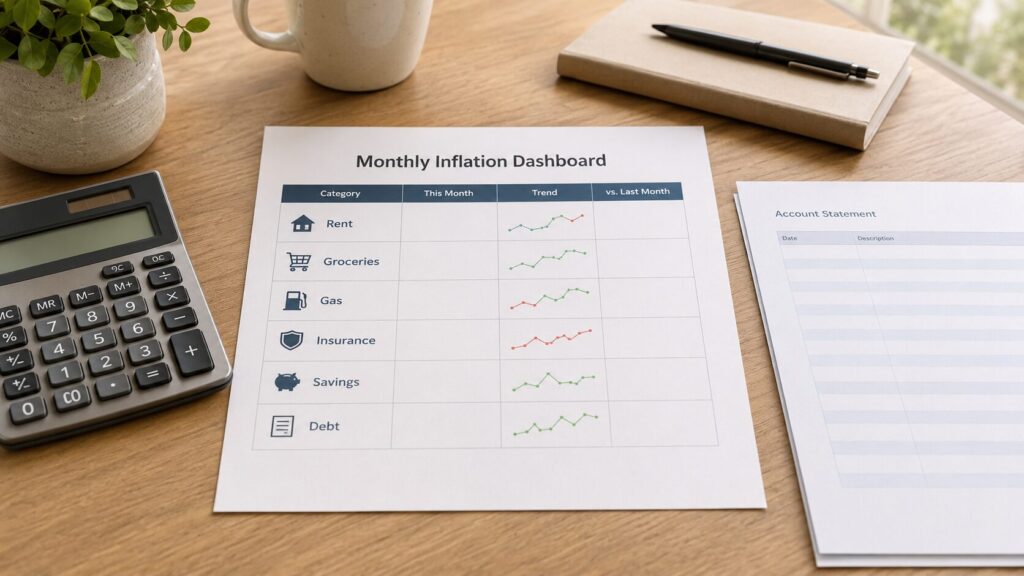
Do not rely on one national inflation number to tell you how your money is doing. Track CPI for consumer price pressure, PCE for Fed policy direction, and your own monthly expenses for reality. Once a month, compare your income growth with your biggest spending categories and adjust savings, debt payoff, or spending before inflation quietly eats the difference.
Reviewed by: The Finance Orbit Editorial Team
Reviewed and updated: July 19, 2026
This article is for general educational and informational purposes only and does not constitute financial, investment, tax, legal, insurance, or credit advice. Products, rates, laws, limits, eligibility rules, and terms can change. Verify current information and consult a qualified professional for advice specific to your circumstances.