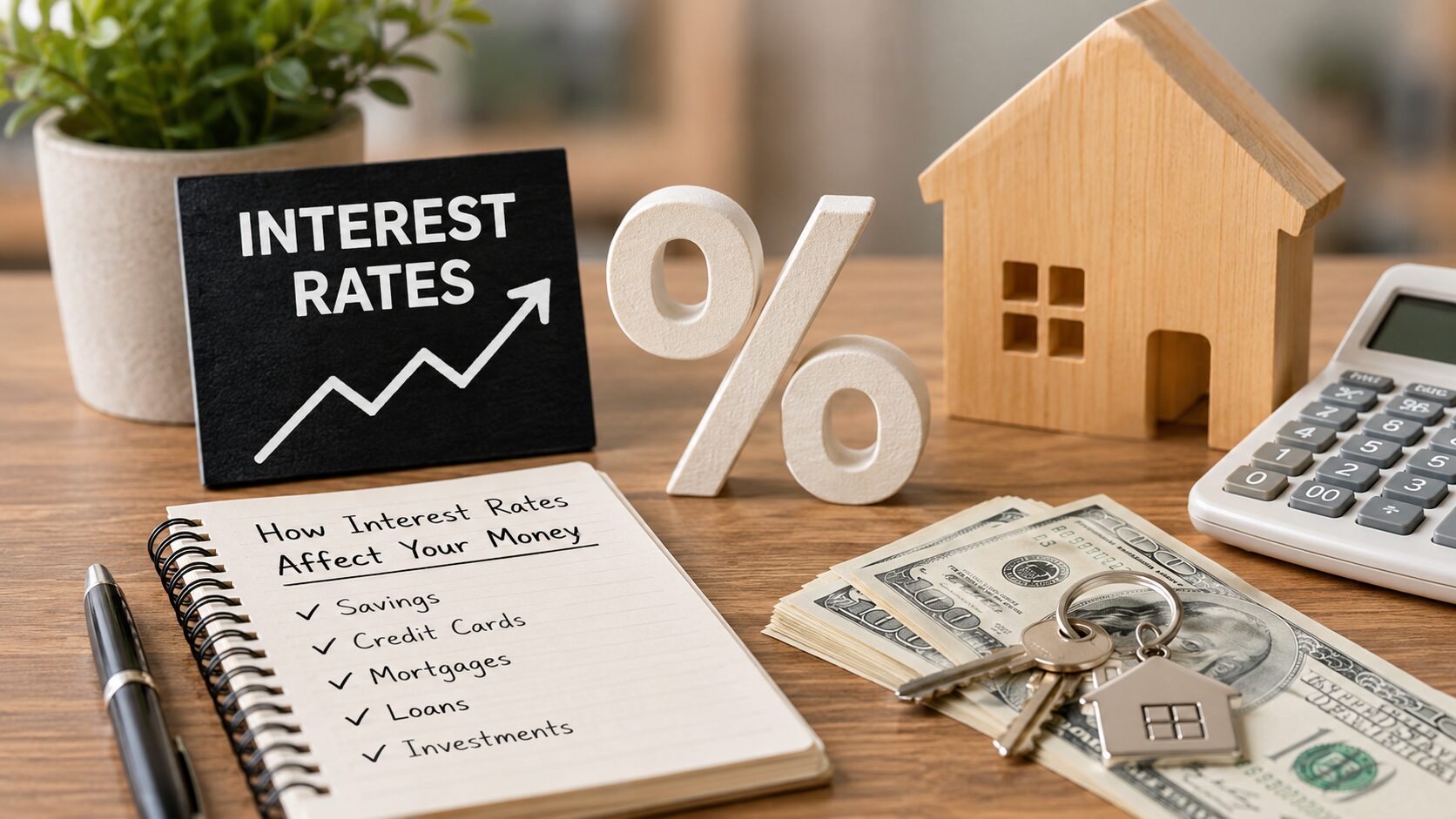
Quick Answer: Interest is the price you pay to borrow money or the reward you earn for letting a bank or borrower use your money. When the Federal Reserve changes its target for the federal funds rate, it does not directly set your mortgage rate, credit-card APR, or savings APY, but it strongly influences how banks and lenders price many financial products. As of the Fed’s June 17, 2026 statement, the target range is 3.50% to 3.75%, with the next scheduled FOMC meeting set for July 28–29, 2026.
Understanding how interest rates work helps you make better decisions about savings, debt, mortgages, and investing. The goal is not to predict every Fed move. It is to know which parts of your money life reprice quickly, which move slowly, and what you can control before rates change again.
How Interest Rates Work
Interest is the cost of using money over time. If you borrow, interest is what you pay the lender. If you deposit money in a savings account or own certain fixed-income investments, interest is what you may earn for allowing another institution to use your money.
A basic estimate is:
Balance × interest rate × time = approximate interest paid or earned
For example, a $10,000 balance at 5% for one year is roughly $500 before compounding, fees, taxes, or payment changes. The same 5% can help you when you earn it and hurt you when you pay it. For a deeper walkthrough, see how to calculate compound interest.
APR vs. APY
APR usually describes the annual cost of borrowing, though the exact calculation depends on the product. Credit cards, personal loans, auto loans, and mortgages commonly quote APR.
APY describes annual deposit yield after compounding. A savings account with daily or monthly compounding can have an APY that differs from its stated interest rate.
When borrowing, a lower APR is generally better. When saving, a higher APY is generally better, assuming fees, access, and account safety are comparable.
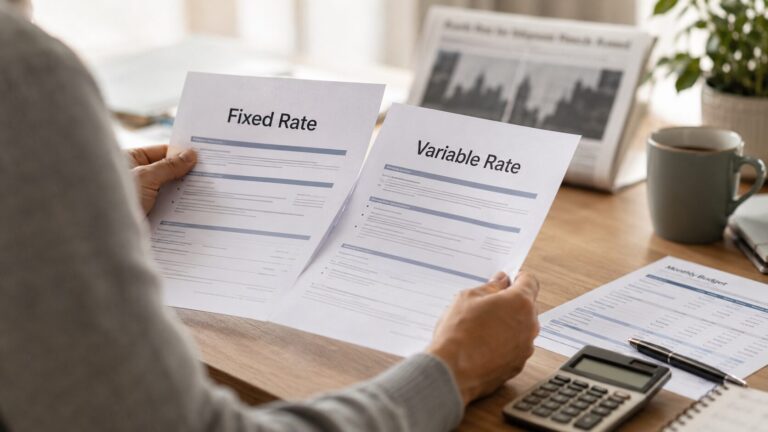
Fixed vs. variable rates
A fixed rate generally remains the same for the agreed term. A fixed-rate mortgage keeps the same principal-and-interest rate even if the Fed changes policy later.
A variable rate can change. Credit cards, HELOCs, adjustable-rate mortgages, and some private student or personal loans may reprice when a benchmark changes. These products are often where Fed rate changes reach a household budget fastest.
What the Fed Actually Controls
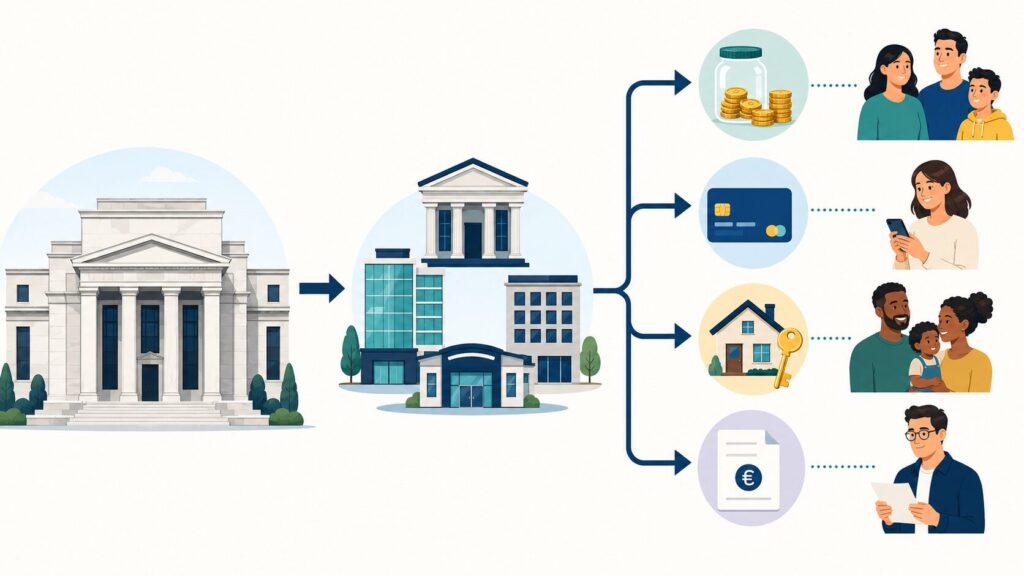
The Federal Reserve does not set your bank’s savings APY or your lender’s exact mortgage offer. Its main rate tool is the target range for the federal funds rate, an overnight rate used in transactions between eligible institutions. Fed policy influences short-term rates, credit conditions, longer-term rates, asset prices, and expectations.
When the Fed raises rates, it is typically trying to restrain inflation by making credit more expensive and encouraging saving. When it cuts rates, it is typically trying to support economic activity by easing financial conditions. The effect is neither instant nor equal across products.
How Fed Rate Changes Affect Your Money
| Money area | When rates rise | When rates fall | What to watch |
|---|---|---|---|
| Savings accounts | APYs may increase, especially at competitive banks | APYs may decline | Rate changes, fees, withdrawal rules, FDIC or NCUA coverage |
| Credit cards | Variable APRs often rise | APRs may fall, but balances can remain expensive | APR, fees, minimum payment, payoff timeline |
| Mortgages | New fixed-rate offers may become more expensive | Offers may improve if bond yields and lender pricing fall | Rate lock, points, closing costs, break-even period |
| Personal and auto loans | New loans may cost more | New loans may become cheaper | APR, fees, term length, total interest |
| Investments | Cash and bonds may become more attractive; some valuations may face pressure | Assets can respond differently depending on growth and inflation | Time horizon, diversification, risk tolerance |
Savings accounts and CDs
Savings accounts often respond to Fed policy, but banks do not all move at the same speed. Some raise yields to attract deposits, while others lag. The national average can also be far below competitive online savings offers.
If you keep an emergency fund or other near-term cash, compare your current yield with a high-yield savings account. Savings APYs are variable, so a strong rate today can fall after Fed rate cuts.
Credit cards and variable-rate debt
Credit cards are among the fastest places consumers feel higher rates. In May 2026, the Federal Reserve reported an average rate of 20.94% across all credit-card accounts and 22.15% for accounts assessed interest.
If you carry a balance, your card’s APR, balance, fees, and monthly payment matter more than the federal funds rate itself. A credit-card payoff calculator can show how extra payments change your timeline and total interest.
Mortgages
Mortgage rates are influenced by Fed policy but do not mechanically track the federal funds rate. Fixed mortgage rates are more closely connected to longer-term bond yields, inflation expectations, lender margins, and housing-market conditions.
Freddie Mac reported average rates of 6.55% for a 30-year fixed mortgage and 5.93% for a 15-year fixed mortgage for the week of July 16, 2026. Before buying or refinancing, use a mortgage calculator and compare the payment, closing costs, points, and break-even period.
Personal and auto loans
Personal and auto loans are priced from market rates, lender funding costs, credit risk, income, term length, and collateral. The Federal Reserve reported an average 24-month personal-loan rate of 11.86% at commercial banks in May 2026.
A lower rate can help, but a longer term may still increase total interest. Compare monthly payment and total cost with a personal-loan calculator.
Investments and retirement accounts
Higher rates can make cash and bonds more attractive, pressure some stock valuations, and increase borrowing costs for companies. Lower rates can support borrowing and asset prices, but they may also reflect concerns about slowing growth.
For long-term investors, rate changes are usually a reason to review risk, diversification, and near-term cash needs—not to make emotional, all-or-nothing moves. A compound-interest calculator can help model long-term growth assumptions.
What a One-Point Rate Change Can Cost
These are estimates, not predictions. They show why the same rate change can feel small in a savings account but large on a mortgage.
Savings: $20,000 at 3.50% vs. 4.50%
- At 3.50%, $20,000 earns about $700 in one year.
- At 4.50%, $20,000 earns about $900 in one year.
- Difference: about $200 before taxes and compounding differences.
To plan a target balance, use a savings goal calculator.
Credit card: $5,000 at 20.94% vs. 21.94%
Assume no new purchases, no payments for one year, and daily compounding for illustration.
- At 20.94% APR, estimated one-year interest is about $1,164.
- At 21.94% APR, estimated one-year interest is about $1,226.
- Difference: about $62.
Actual interest depends on daily balances, payments, grace periods, fees, and card terms.
Mortgage: $300,000 over 30 years
These estimates cover principal and interest only. Taxes, insurance, PMI, HOA dues, points, and closing costs are excluded.
| Fixed rate | Estimated monthly principal and interest | Estimated total interest |
|---|---|---|
| 5.55% | $1,713 | $316,604 |
| 6.55% | $1,906 | $386,189 |
| 7.55% | $2,108 | $458,853 |
At this loan size, moving from 6.55% to 5.55% reduces the estimated payment by about $193 per month and total interest by about $69,584 if the loan is held for the full term. Moving from 6.55% to 7.55% adds about $202 per month and roughly $72,664 in total interest.
A Practical Rate-Change Action Plan
1. Separate fixed from variable
List every loan and account as fixed or variable. Fixed-rate debt may not change at all, while variable-rate debt can reprice quickly.
2. Rank debts by APR
Prioritize high-rate revolving debt, especially credit cards. When comparing payoff or consolidation options, include fees, total cost, and the risk of extending repayment.
3. Compare cash APY
Check what your emergency fund earns. Moving idle cash to a safe, competitive account may help, but do not sacrifice needed liquidity for a small yield increase.
4. Check refinance break-even
Divide refinance closing costs by monthly savings. A $4,000 refinance that saves $160 per month takes about 25 months to break even. If you expect to move or repay sooner, the refinance may not pay off.
5. Compare total cost, not only monthly payment
A longer term can make a payment look affordable while increasing total interest.
6. Review actual account terms after a policy change
Headlines do not determine your personal rate. Check your bank APY, card APR, loan offer, or mortgage quote after conditions change.
Common Interest-Rate Mistakes
Assuming the Fed sets every rate
The Fed influences rates but does not set every consumer rate directly. Mortgage rates can move before a meeting when markets already expect a policy change.
Comparing APR and APY as though they are identical
APR is commonly used for borrowing, while APY incorporates compounding for deposits. Context matters.
Keeping expensive debt while chasing a small savings yield
Earning 4% on savings while paying 22% on a card is generally costly, though emergency liquidity and near-term bills still matter.
Refinancing without counting fees
A lower rate can still be a poor deal if closing costs are high and you will not keep the loan long enough to break even.
Locking up all available cash
CDs can be useful, but early-withdrawal penalties and emergency access matter.
Treating forecasts as guarantees
Fed projections and market forecasts are not promises. Build a plan that works under more than one rate scenario.
Quick Summary
- Interest rates affect what you earn on savings and what you pay on debt.
- The Fed mainly influences short-term rates through the federal funds rate; it does not directly set consumer loan rates.
- Credit cards, HELOCs, and many variable-rate loans usually react faster than fixed-rate mortgages.
- Savings yields can rise when rates are high and fall after Fed rate cuts.
- A one-percentage-point change can have a modest effect on savings but a large effect on a mortgage or major debt balance.
- APR usually describes borrowing costs, while APY reflects compounding on savings.
- A personal rate map can help you prioritize debts, savings, and reset dates.
Frequently Asked Questions
Does the Fed set mortgage rates?
No. The Fed does not directly set mortgage rates. It influences the broader rate environment, while mortgage rates also depend on longer-term bond yields, inflation expectations, lender pricing, credit risk, and housing-market conditions.
What happens to savings rates when the Fed cuts rates?
Savings rates often fall after Fed rate cuts, especially on variable-rate savings and money-market accounts. Banks may adjust at different speeds. CDs can lock a rate for a set term but reduce liquidity.
Why do credit-card APRs change so quickly?
Many credit-card APRs are variable and tied to benchmark rates. When a benchmark rises, issuers may adjust APRs according to the card agreement, making carried balances more expensive.
Is a higher interest rate always bad?
No. Higher rates can hurt borrowers but help savers earn more on cash. The net effect depends on your mix of variable-rate debt, fixed-rate debt, and interest-earning savings.
Should I wait for Fed rate cuts before buying a home?
Not automatically. Mortgage rates, home prices, inventory, income, credit, down payment, taxes, insurance, and how long you plan to stay all matter. Test the payment at today’s rate and at a somewhat higher rate before deciding.
What is the difference between APR and APY?
APR generally describes annual borrowing cost, while APY reflects annual deposit yield after compounding. Lower APR is usually better for borrowers; higher APY is usually better for savers when fees, access, and risk are comparable.
Build Your Personal Rate Map
Create a one-page list with four columns: account or loan, balance, rate, and fixed or variable. Add the next action for each item—compare APY, pay down faster, refinance only if the break-even works, or leave unchanged.
Start with accounts that reprice fastest, including credit cards, HELOCs, savings accounts, and new loan offers. Then review larger, longer-term decisions such as mortgages, auto loans, and investments. Once you know where rates touch your money, Fed news becomes easier to translate into practical decisions.
Reviewed and updated: July 17, 2026
Disclaimer: This article is for general educational purposes only and is not financial, tax, legal, or investment advice. Rates, terms, taxes, and eligibility rules change. Check current offers and consult a qualified professional for advice specific to your situation.